No Products in the Cart
Buy 3 Shirts - Shipping Is On Us (Excludes Custom Orders) !




The Flying Tigers painted shark mouths on their P-40s after seeing the design on a Royal Air Force No. 112 Squadron Tomahawk. The teeth gave the aircraft a menacing face and became closely associated with the American Volunteer Group. The Flying Tigers made the look famous; they did not invent it.
That distinction is part of what makes the artwork worth knowing. Our Flying Tigers Airplane Shirt draws on this recognizable piece of WWII aviation history, rather than a generic airplane silhouette.
The American Volunteer Group, usually shortened to AVG, brought American pilots and support personnel to the effort to defend China against Japan. Claire Chennault led the group. The National Archives’ Flying Tigers exhibit documents the group and preserves a wartime photograph of its shark-faced P-40s in China.
Remembering the ground crews matters, too. Pilots could not keep aircraft operating without the people maintaining engines, installing radios and doing the less-photographed work around the airfield.
The nickname and the nose artwork are different visual references. According to the Library of Congress Veterans History Project, AVG members adopted the shark-mouth pattern after seeing a photograph of No. 112 Squadron’s Tomahawk. The account describes the aircraft markings in the context of psychological warfare: the intent was an intimidating appearance.
That does not mean paint made the fighter faster or decided a battle. The design’s lasting strength is visual. A row of teeth wrapped around the nose is immediately recognizable, even to someone who cannot name every P-40 variant.
The aircraft most strongly associated with the Flying Tigers is the Curtiss P-40. The National Museum of the U.S. Air Force’s P-40 overview describes a fighter known for ruggedness, even when opponents had advantages in speed or maneuverability. It also makes clear that P-40 service extended well beyond the Flying Tigers.
That is useful context when looking at warbird artwork. A shark-mouth aircraft is a strong visual cue, but it is not enough on its own to establish an airplane’s exact unit, date or service history.
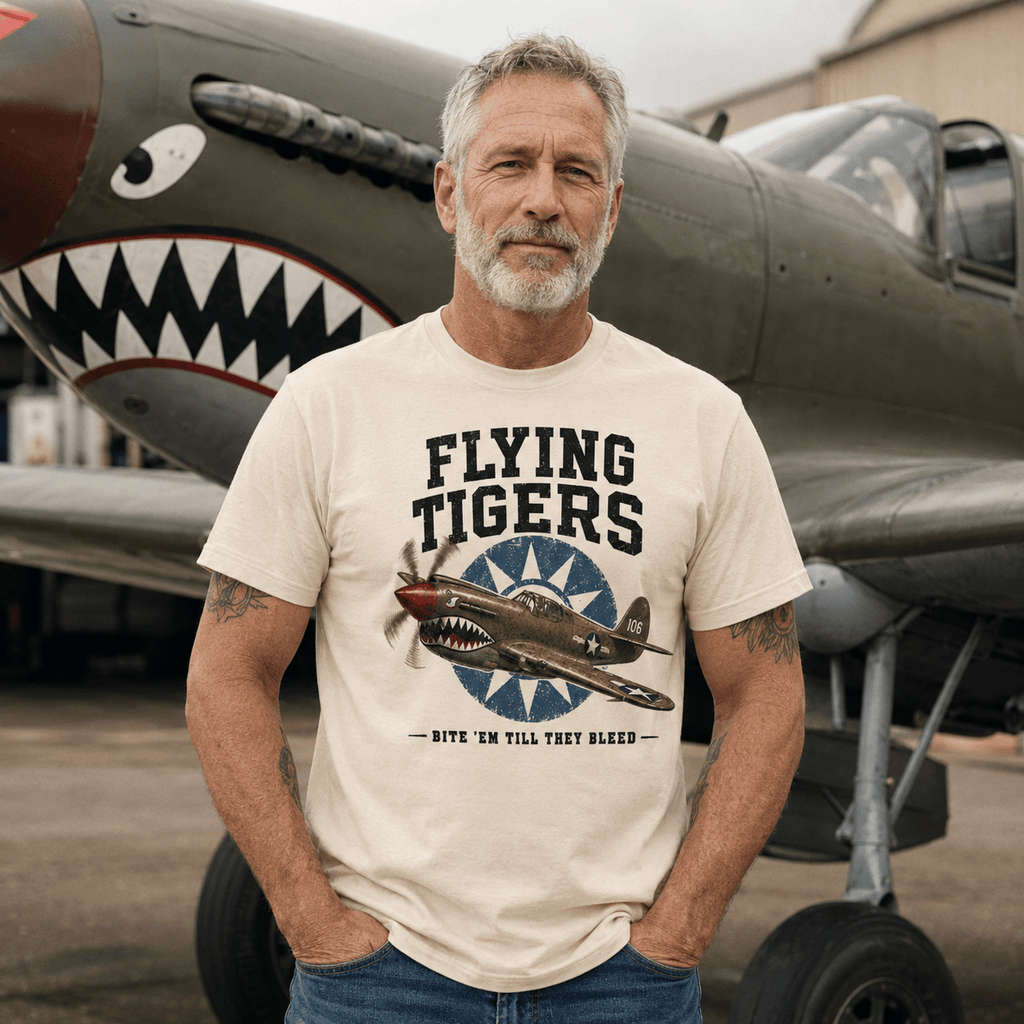
The design combines Flying Tigers lettering, a shark-mouth fighter illustration and distressed artwork on a light-colored tee. The product photo above shows the actual design sold by Veteran Shirts, including its print placement. It is contemporary aviation-inspired apparel—not a wartime uniform, an original artifact or a claim that the wearer served with the AVG.
For a gift, start with the recipient’s interest. This shirt is a natural match for someone who studies the China-Burma-India theater, enjoys P-40 warbirds or collects aviation-history books. Someone who mainly follows airborne units or tanks may prefer a different design.
Browse the Flying Tigers Airplane Shirt for current options, or compare airborne, armor and aviation designs in our WWII shirt guide. The WWII shirts collection brings those different stories together.
